If they don't, an application goes to Leeds City Council: full plans for any work, or a building notice for minor work that hasn't started yet, though not for flats or work near a public sewer. Planning permission is a separate matter and mostly arises if the roof's appearance changes or you're in one of Leeds's 80 conservation areas.
Is your roof job a repair or notifiable work?
According to the government's guide to building work, replacements and repairs, replacing a roof covering must be notified to building control. The Planning Portal says re-roofing will need building regulations approval "in most situations". By contrast, swapping a few tiles, re-bedding ridge tiles or renewing a length of flashing are repairs.
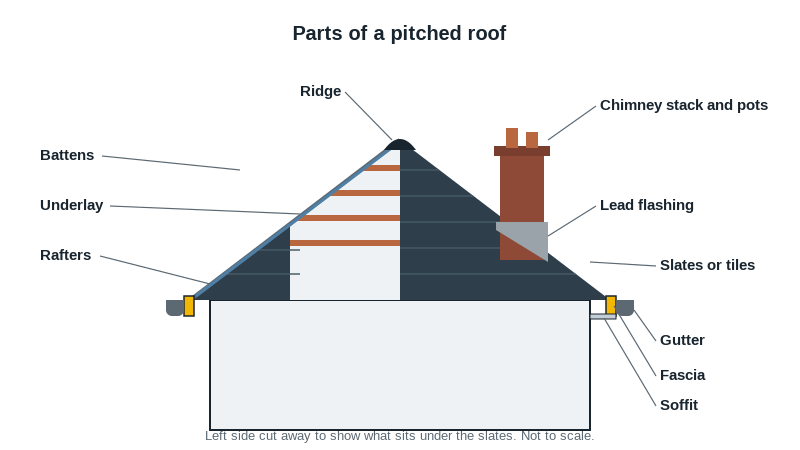
Why the rules? A new covering can change the load on the rafters, particularly when lighter slate is swapped for heavier concrete tiles, and it's a chance to improve insulation. When a roof is re-covered, building regulations generally expect its thermal performance to be upgraded where that's practical, often by topping up loft insulation or adding insulation into a flat roof build-up.
How do competent person schemes work?
Approved schemes allow registered tradespeople to sign off their own work. For roofing, CompetentRoofer is the main one, and the government's guidance also mentions NAPIT. Your roofer notifies the job through the scheme and you receive a certificate. Keep it safe: when you sell, the buyer's solicitor is likely to ask for it.
What are Leeds City Council's application routes?
| Route | What Leeds says it's for | Points to know |
|---|---|---|
| Full plans | Any building work | Plans checked; no payment needed when you submit |
| Building notice | Minor works not yet started | Not for commercial buildings, flats, or work over or near a public sewer |
| Regularisation | Work done without approval | For work completed on or after 11 November 1985 |
Leeds works out fees from published tables, showing prices with and without VAT. Its full plans table lists "renovation of a thermal element to a single dwelling" at £325 including VAT; ask building control which category your job falls into. Once your application is accepted, the council emails an application number and the charge, payable within 28 days. Source: Leeds City Council, apply for building regulations approval, read 21 November 2026. Fees change, so check the current table.
Who should sort out the approval?
As the owner, you can be the one the council pursues if work doesn't comply, even if the roofer promised to sort it. Agree in writing who will notify and by which route before work begins. If a roofer tells you a full re-roof doesn't need notifying, ask them to explain why in writing.
When does roof work need planning permission?
Re-roofing a house in similar materials normally doesn't. You're more likely to need consent if you:
- alter the roof shape or height, or put a dormer on a front slope;
- live in a flat or maisonette, which has more limited permitted development;
- own a listed building, where even like-for-like work may need listed building consent;
- live in a conservation area and the work changes how the roof looks.
What changes inside Leeds conservation areas?
Leeds City Council lists 80 conservation areas, 55 of which have a published appraisal describing what makes them special. Its guidance explains that inside them, permission can be needed for alterations such as dormers, some chimney work, flues and some solar panels. If your roof is visible from the street, matching materials are the safe choice, and it's worth asking the council before altering stacks or adding panels. Source: Leeds City Council, conservation areas.
Do Leeds back-to-backs need special care?
Back-to-back terraces share walls on three sides, and their roofs often run continuously across neighbouring houses. Council-led improvement schemes, such as one covering around 100 homes in Armley's Cedars area reported in 2024, show how much attention these streets get. For roof work, that means talking to neighbours about access and shared details such as party-wall upstands and chimneys, and checking whether your street is in a conservation area before changing materials.
What about solar panels and roof windows?
Panels and rooflights on a house roof are often permitted development, subject to conditions such as not projecting too far from the roof slope. Inside a Leeds conservation area, the council's guidance flags some solar installations as needing permission, so check first if your roof faces the street. If you're planning panels and a new roof, fit the mounting points while the roof is open and the scaffold is up; it saves paying for access twice.
What if you're buying a house with a newer roof?
Ask the seller for the competent person certificate or the council completion certificate for any re-roof in recent years, along with the guarantee. If neither exists, your solicitor may suggest indemnity insurance or a regularisation application to Leeds City Council. It's easier to sort out before exchange than after.
Five questions to settle before the scaffold goes up
- Is this a repair, or a full re-covering?
- If it's a re-roof, is the roofer in a competent person scheme you've checked?
- If not, has a full plans or building notice application gone in to Leeds?
- Will the roof look different, or are you in a conservation area?
- Who will hand you the certificate at the end?