

Many of the city's older terraces and semis still have their original stacks, and the joint where the chimney meets the roof is one of the most common sources of leaks. Spotting it early usually means a flashing or pointing job rather than a rebuild.
What are the signs your chimney needs repairing?
- A damp patch on the chimney breast inside, or on the ceiling next to it.
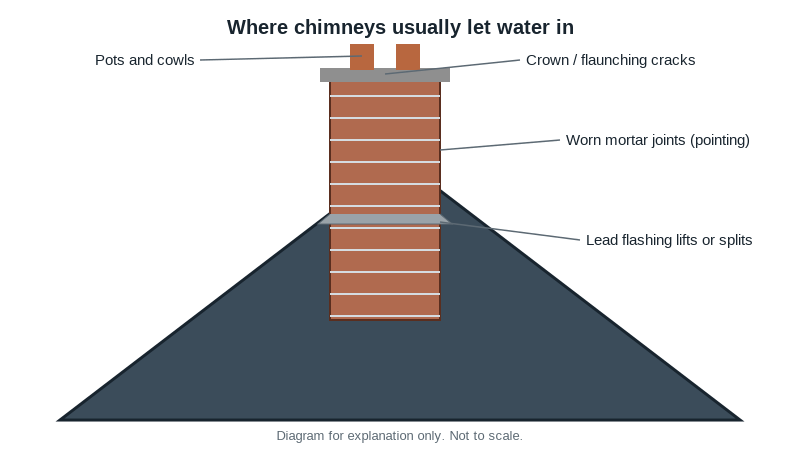
- Crumbling or missing mortar between the bricks or stones.
- A cracked concrete cap (the crown or flaunching) around the pots.
- Lead flashing that has lifted, split or slipped down.
- A stack that visibly leans.
- Bits of brick, mortar or pot found in the garden or the fireplace.
A leaning stack or falling masonry is a safety issue. Keep people away from the area below and get it looked at quickly.
How much do chimney repairs cost?
| Job | Price | VAT | Source |
|---|---|---|---|
| Chimney flashing repair | £300 to £800 | VAT not stated | MyJobQuote, 2026-10-06 |
| Lead flashing repair, general | £250 to £700 | VAT not stated | MyJobQuote, 2026-10-06 |
| Chimney repointing, small stack | £300+ | VAT not stated | Whito, 2026-09-17 |
| Chimney partial rebuild | £600 to £1,000 | VAT not stated | Whito, 2026-09-17 |
| Chimney full rebuild | £1,000 to £3,500 | VAT not stated | Whito, 2026-09-17 |
| Chimney removal | £260 to £340 per metre | VAT not stated | Whito, 2026-09-17 |
Access usually adds to these prices. A tower or scaffold around the stack is needed for most chimney work, and on a steep or high roof that can be a large part of the bill. Ask whether it's included.
Which repair do you need?
Is it the flashing?
If the damp patch is where the chimney meets the ceiling, the lead flashing is the most likely cause. It can lift in high winds or crack with age. A repair usually means re-dressing or replacing the lead and sealing it into the mortar joints.
Is it the pointing?
If the mortar is soft, crumbly or missing, rain soaks into the stack. Repointing means raking out the old mortar and filling with new. On older stone chimneys, a lime mortar may be more suitable than a hard cement mix; ask your roofer which they'd use and why.
Is it the crown or pots?
The concrete crown around the pots cracks over time and lets water straight down the inside of the stack. Re-flaunching replaces it. Pots can also be capped or fitted with cowls if the fireplace is no longer used, which keeps out rain and birds while still letting the flue breathe.
Does it need rebuilding?
A stack that leans, or has lost a lot of masonry, may need partly or fully rebuilding. This is a bigger job and should come with a clear written quote.
Should you remove a chimney?
Some people remove a stack they no longer use, especially if it needs expensive work. Removing the part above the roof is one thing; taking out a chimney breast inside affects the structure and needs building regulations approval and, if it's shared, a party wall agreement with your neighbour. Chimneys in conservation areas are often treated as part of the street scene, so check before removing one that's visible from the road.
Chimneys and planning in Sheffield
Sheffield has 38 conservation areas within its boundary. Repairs using matching materials are normally fine, but removing or significantly altering a visible stack may need consent in some of them. Three of them, around Bradfield and Upper Midhope, are administered by the Peak District National Park Authority rather than the council. See our building regulations guide for links to the council's pages.
What happens during a chimney repair?
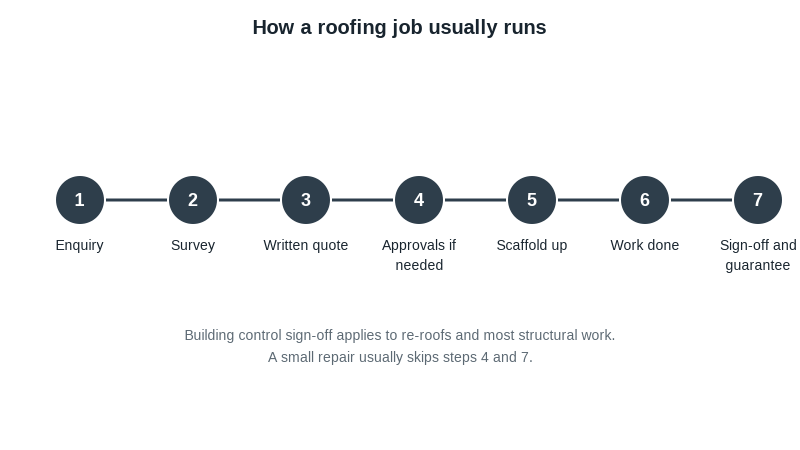
- Inspection, from the roof or a drone or camera, to find the actual fault.
- Written quote, including access equipment.
- Access set up: a tower, roof ladder or scaffold.
- Repair, whether flashing, pointing, crown or rebuild.
- Photos of the finished work, since you can't easily see it from the ground.
How can you stop a chimney leaking again?
Most chimney leaks come back because the cause wasn't fixed, only the symptom. A roofer who seals a crack with mastic and leaves may stop the drip for a season. A lasting repair usually means replacing failed lead with properly dressed lead set into the mortar joints, repointing with a suitable mortar, and renewing a cracked crown. If the fireplace is no longer used, capping the pots with a ventilated cap stops rain going straight down the flue. Ask the roofer to explain why the leak happened, and to show you photos of the cause before and after.
How often should a chimney be checked?
A look from the ground with binoculars once a year, ideally after the winter storms, will spot leaning pots, missing mortar and lifted lead. If you're having other roof work done, ask the roofer to look at the stack while they're up there; it costs little extra when the access is already in place.
While the scaffold is up
If you're paying for access to the chimney, ask the roofer to check the nearby tiles, ridge and gutters at the same time. Small extra jobs cost less when the access is already there. Our roof repairs page lists typical prices.
