

Published prices put flashing repairs at £300 to £800, a partial rebuild at £600 to £1,000 and a full rebuild at £1,000 to £3,500, with access equipment often on top. In Leeds conservation areas, some chimney alterations need planning consent, so check before taking a visible stack down.
How can you tell what's wrong with your chimney?
| What you notice | Likely cause |
|---|---|
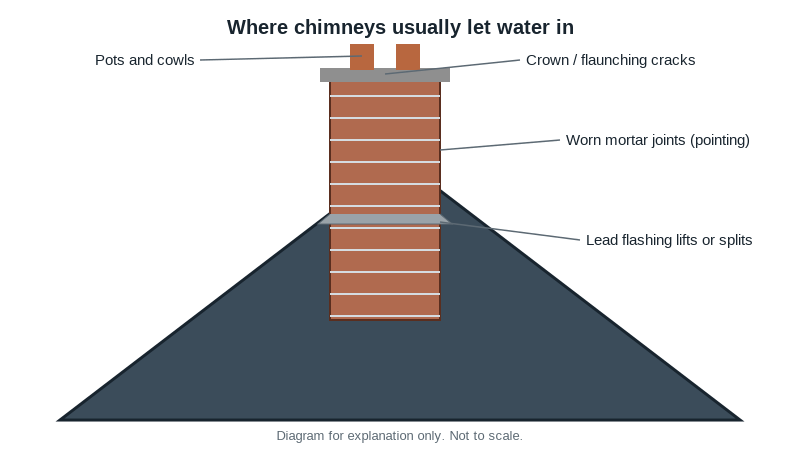
| Damp on the ceiling right beside the chimney breast | Lead flashing lifted or split |
| Damp patch higher up the chimney breast, or in the loft on the stack | Porous brickwork or failed pointing |
| Water or debris in the fireplace | Cracked crown, or uncapped pots |
| Mortar crumbs or brick fragments in the garden | Weathered pointing or loose masonry |
| Stack visibly leaning | Structural movement; urgent inspection needed |
If anything has fallen, or the stack leans, keep people away from beneath it until it's been checked.
What does chimney work cost?
These figures from MyJobQuote and Whito don't state whether VAT is included, so they're shown as published.
| Work on the stack | From | To | Published by |
|---|---|---|---|
| New or re-dressed flashing | £300 | £800 | MyJobQuote (2026-10-06) |
| Lead work generally | £250 | £700 | MyJobQuote (2026-10-06) |
| Repointing, small stack | £300 | £300+ | Whito (2026-09-17) |
| Rebuilding the top section | £600 | £1,000 | Whito (2026-09-17) |
| Rebuilding the whole stack | £1,000 | £3,500 | Whito (2026-09-17) |
| Taking a stack down | £260 per metre | £340 per metre | Whito (2026-09-17) |
Access is usually the swing factor. Most stacks need a tower, roof ladder system or scaffold; on a tall terrace or a steep roof, that can rival the cost of the repair. Make sure it's itemised.
Which repair will fix the problem for good?
Flashing. Lead that has lifted or cracked should be re-dressed or replaced and properly set into the mortar joints. Mastic alone is a short-term patch.
Pointing. Soft or missing mortar lets rain soak into the stack. Repointing rakes it out and refills it. On older brick or stone, a softer lime mortar is often more suitable than hard cement; ask which your roofer plans to use.
Crown and pots. The sloped mortar cap around the pots cracks and lets water straight down inside. Re-flaunching replaces it. Unused flues can be capped with a ventilated cap, which keeps rain and birds out while still letting the flue breathe.
Rebuild. A leaning or badly weathered stack may need taking down and rebuilding above the roof line, matching bricks where possible.
A good roofer tells you why the leak happened and shows photos of the cause, not just the fix.
Can you take a chimney down in Leeds?
Removing the stack above roof level is a common way to avoid repeated repair bills on a chimney you don't use. But Leeds City Council's conservation guidance notes that in its 80 conservation areas, some chimney work needs permission, because stacks form part of the roofscape. Taking out a chimney breast indoors is a structural change that needs building regulations approval, and a party wall agreement if the stack is shared with next door, which it often is on terraces and back-to-backs. See our building rules guide.
Should you keep a chimney you don't use?
Plenty of Leeds homes have stacks serving fireplaces that were blocked up decades ago. You have three realistic options. Keep and maintain it: occasional pointing and flashing work, and a ventilated cap on the pots. Reduce it: take the stack down to below the roof line and tile over, which removes the maintenance but needs care with ventilation of the old flue and, in a conservation area, may need consent. Or leave it alone until something fails, which is the most common choice and the most expensive when it goes wrong. On a shared stack, involve your neighbour early: the work, the cost and the scaffold all affect both houses.
Lime or cement for repointing?
Many Victorian and Edwardian chimneys in Leeds were built with soft lime mortar. Hard cement mortar used in repairs can trap moisture in the brick and make faces flake off over time. A roofer who works on older homes should be able to tell you which mortar suits your stack and why. If they can't, ask someone else.
Does a chimney need a sweep before repair?
If the fireplace or stove is in use, get the flue swept and checked before work on the stack, and tell the roofer which flues are live. A cap must never block a working flue.
What does a chimney repair job look like?
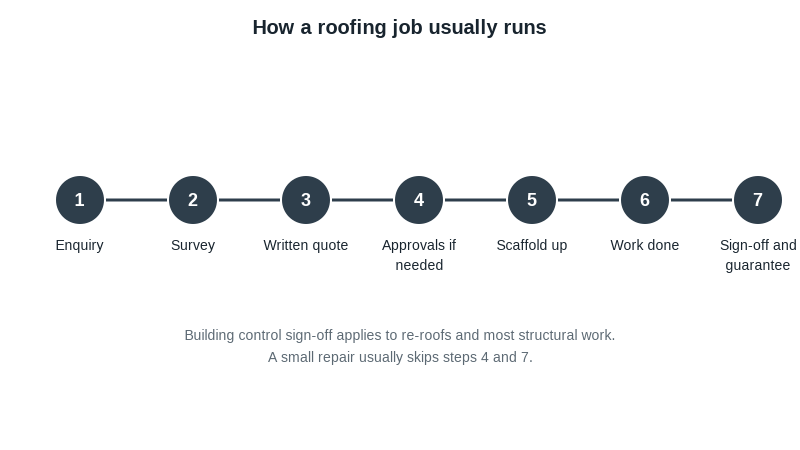
- Inspection from roof level, or by drone or pole camera.
- Written, itemised quote including access.
- Access set up safely.
- Repair carried out: lead, pointing, crown, pots or rebuild.
- Photos of the finished work.
How often should you check your chimney?
Once a year, after winter, scan it from the street or garden, with binoculars if you have them: leaning pots, gaps in the mortar, lead that's lifted. If a roofer is up there for something else, ask them to look at the stack and send you a photo. It costs little when access is already in place, and our roof repairs page lists typical prices for jobs that can be combined.
